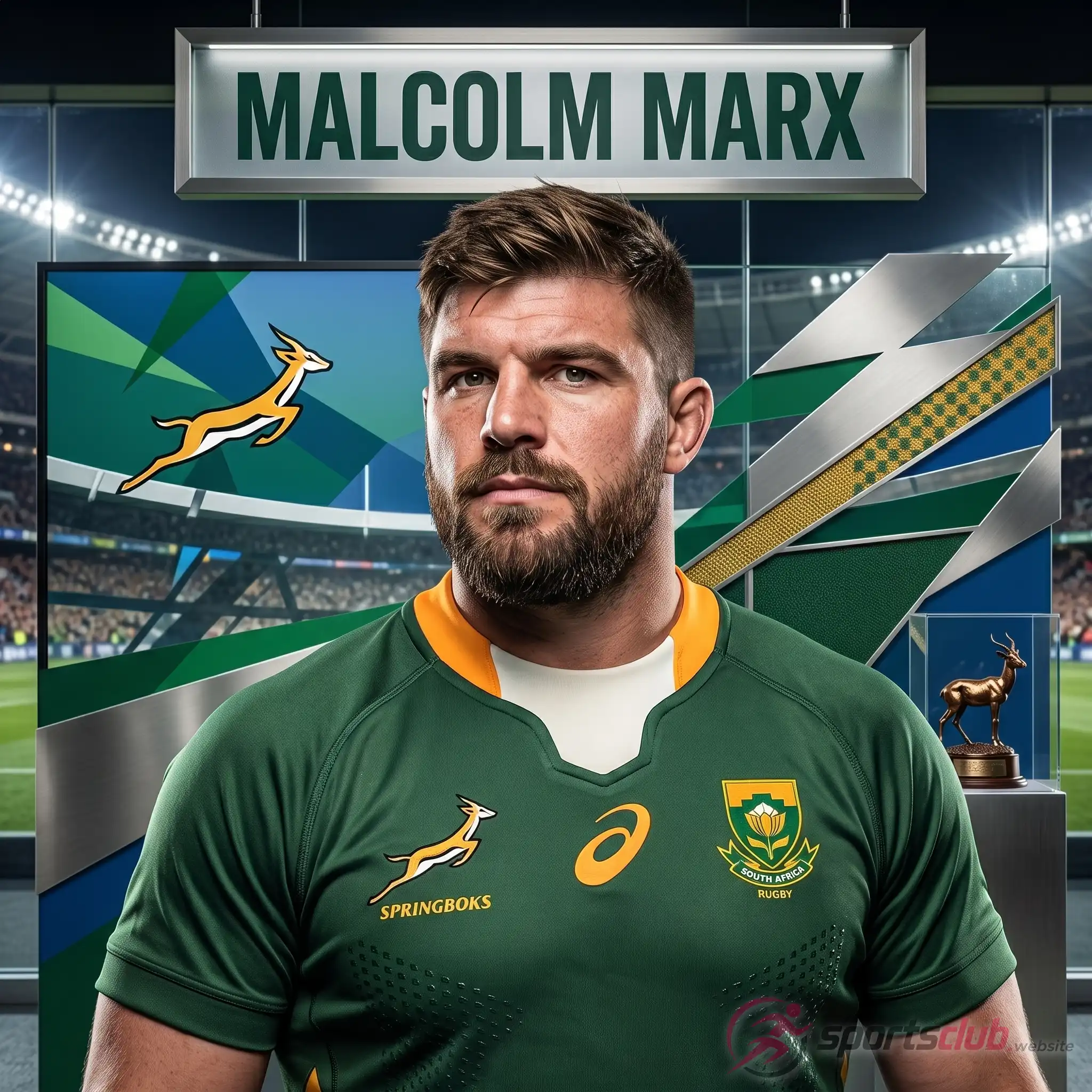
1. Malcolm Marx Profile
| Category | Detail |
|---|---|
| Full Name | Malcolm Justin Marx |
| Date of Birth | 13 July 1994 |
| Birthplace | Germiston, Gauteng, South Africa |
| Nationality | South African |
| Height / Weight | 1.89 m / approx. 116–117 kg |
| Position | Hooker |
| Current Club | Kubota Spears Funabashi Tokyo-Bay (Japan Rugby League One) |
| International Team | Springboks (South Africa) |
| International Caps | Around 89 (as of the Wales Test in July 2026) |
| Rugby World Cup Appearances | 2019 and 2023 (two-time champion) |
| Test Tries | Mid-to-high 20s (sources place the figure between 25 and 27 as of late 2025 — see note in Section 6) |
| Major Individual Honor | World Rugby Men’s 15s Player of the Year, 2025 |
2. Introduction: Who is Malcolm Marx?
There are very few forwards in the modern game who can be described, without much argument, as the best in the world at their position — but by the end of 2025, Malcolm Marx had become exactly that. When World Rugby handed him the Men’s 15s Player of the Year award, he became the first hooker to win it since Keith Wood claimed the inaugural prize in 2001, a 24-year gap that says as much about the rarity of his game as it does about his longevity.
This Malcolm Marx biography traces the arc of a player who started out as a schoolboy flanker in Johannesburg, was talked into switching to hooker by a Springbok coach who saw something others hadn’t, and went on to become a two-time Rugby World Cup winner, a two-time SA Rugby Player of the Year, and — according to teammates, opposition coaches, and now World Rugby itself — the most complete No. 2 of his generation.
What makes the Malcolm Marx story compelling isn’t just the Malcolm Marx stats — the caps, the tries, the turnovers — but the shape of the career itself: a Super Rugby prodigy who left South Africa mid-career during rugby’s Covid upheaval, rebuilt his game in Japan, and kept fighting his way back into Springbok Test squads through three separate serious setbacks, including a World Cup-ending knee injury in 2023. This piece walks through his Malcolm Marx club career, his Test record, his World Cup history, and what comes next as he heads toward a third World Cup cycle in his mid-thirties.
3. Malcolm Marx Early Life & Background
Malcolm Marx was born on 13 July 1994 in Germiston, an industrial town on Johannesburg’s East Rand in South Africa’s Gauteng province. Gauteng has produced a disproportionate share of Springbok forwards over the decades, and the East Rand rugby culture — built around strong school programs and a pipeline into the Golden Lions union — shaped Marx from a young age.
He attended King Edward VII School (KES) in Johannesburg, one of the country’s most storied rugby schools, whose alumni include Springbok wing Bryan Habana and former national cricket captain Graeme Smith. It was at KES that Marx formed a lasting friendship with two other future professional players, Cyle Brink and Dylan Smith — a trio informally nicknamed the “Three Musketeers” by those around the program, who went from schoolboy teammates to, at various points, professional teammates and opponents.
Marx didn’t start out as a hooker. As a schoolboy and age-group player, he played flanker. The positional switch that defined his career came later, at university level, when former Springbok coach Heyneke Meyer watched him play and suggested he try hooker instead. It proved to be one of the more consequential single pieces of advice in modern Springbok history — the raw ball-carrying and breakdown instincts of a loose forward, transplanted into the No. 2 jersey, are a large part of why Marx plays the position the way he does today.
Did You Know?
Malcolm Marx didn’t start his career as a hooker at all — he played flanker throughout school, and only switched positions on the advice of former Springbok head coach Heyneke Meyer.
4. Youth & Academy Career
Marx’s rise through the representative age-group system was steady rather than instant. He represented the Golden Lions at the 2007 Under-13 Craven Week and the 2010 Under-16 Grant Khomo Week — two of South Africa’s most important schoolboy rugby showcases, both key scouting grounds for provincial unions.
By 2012, he had been selected for the prestigious South Africa Schools side, a level that typically marks a player out as a genuine professional prospect. He then enrolled at the University of Johannesburg, playing in the 2013 Varsity Cup, South Africa’s university rugby competition, where he scored four tries in eight appearances as a teenage forward — an eye-catching return that helped accelerate his move into the professional ranks. That same broader period saw him represent South Africa Under-20.
His form for the Golden Lions’ junior structures and at university level earned him a place in the Lions’ senior Super Rugby squad in 2014, aged just 19 — the true beginning of his professional Malcolm Marx club career.

5. Malcolm Marx Club Career Timeline
| Period | Club | Competition | Notes |
|---|---|---|---|
| 2014–2019 | Golden Lions / Lions | Super Rugby, Currie Cup | Debut on 5 April 2014 (Lions v Crusaders); became a Super Rugby regular and multiple-award winner |
| 2020 | NTT Shining Arcs | Japan Top League | Signed after leaving the Lions during South Africa’s Covid-era Industry Salary Plan exit window; scored 5 tries in 6 games before the season was curtailed |
| 2021–present | Kubota Spears Funabashi Tokyo-Bay | Japan Rugby League One | Became a central figure in the club’s pack; contract extended through 2027 |
Marx’s five-year run with the Lions (2014–2019) remains the foundation of his club legacy in South Africa. He featured in 16 of the Lions’ 19 matches during a standout Super Rugby season and finished as the top try-scoring forward in the competition with 12 tries that year — a remarkable return for a front-rower. He was part of the Lions squad that reached the 2016 Super Rugby final, where they were beaten by the Hurricanes.
His individual form for the union was recognized repeatedly: after his 2017 season, he collected the Lions’ Super Rugby Player of the Year, Supporters’ Player of the Year, Players’ Player of the Year, and Most Valued Player of the Year awards in the same season — a clean sweep that reflected both peer and public regard.
The move away from South African rugby came in 2020, when the introduction of the pandemic-driven Industry Salary Plan led several Lions players, Marx among them, to exercise a 21-day contractual exit clause. He signed with NTT Shining Arcs in Japan, before that season was cut short. In 2021 he committed to Kubota Spears, where he has remained ever since, becoming one of the most feared forwards in Japan’s domestic league and extending his contract there through 2027 — meaning his Malcolm Marx club career is now entering its sixth season on Japanese soil.
6. Malcolm Marx International Career & Test Match Record
Malcolm Marx made his Springbok debut on 17 September 2016, coming off the bench against New Zealand in Christchurch during a Rugby Championship match South Africa lost heavily. It was an unglamorous starting point for what would become one of the most decorated international careers of any modern hooker.
He earned his first Test start against France in June 2017, and from there his rise was rapid: he started all six of the Springboks’ Rugby Championship matches that year, and on 24 June 2017 scored his first Test try in a 35–12 win over France. That 2017 season — twelve Test starts from the June series through the end-of-year tour finale in Cardiff — is widely regarded as the campaign that turned Marx from a promising Super Rugby forward into a Springbok the whole game was watching. It earned him the SA Rugby Player of the Year award for 2017, remarkable for a player still in only his second full international season.
By the end of 2018, Marx had accumulated 24 Test caps and 4 tries, and he was shortlisted for the World Rugby Player of the Year award (won that year by Ireland’s Jonathan Sexton) — recognition that he had already established himself among the sport’s true elite, despite playing one of rugby’s least individually glamorous positions.
His cap count has climbed steadily since, interrupted at times by injury and by his relocation to Japan (which occasionally complicated selection logistics but never his eligibility). As of the Springboks’ Test against Wales in Durban in mid-July 2026, Marx — then 32 years old — was closing in on his 89th Test cap, a milestone he described as something he never takes for granted, having dreamed of playing for South Africa since childhood.
Try-scoring note: Public sources differ slightly on Marx’s exact career try tally, a common issue with heavily-capped forwards whose scores are tallied across multiple competitions and updated at different times. As of November 2025, reputable trackers placed him at roughly 25 to 27 Test tries, making him one of the most prolific forward try-scorers in Springbok history. Given the discrepancy between sources, readers wanting an exact up-to-the-match figure should check World Rugby’s official statistics database.
Did You Know?
Malcolm Marx’s first Springbok Test try came against France on 24 June 2017 — the same match in which he made just his second career Test start.
7. Malcolm Marx Rugby World Cup Performances
Marx has now featured in two Rugby World Cup cycles, in 2019 and 2023, with South Africa winning the tournament both times — though his personal experience of the two events could hardly have been more different.
2019 Rugby World Cup (Japan) — Champion
Marx started South Africa’s tournament opener against New Zealand in Yokohama, a match the Springboks lost 23–13, before featuring off the bench in five further matches as Bongi Mbonambi took the starting hooker role. His most decisive moment came in the final against England: with South Africa leading, Mbonambi went off with a head injury a little over 20 minutes in, and Marx came on to help see out a 32–12 victory. He was part of the Springboks’ famous “Bomb Squad” bench strategy that tournament, finishing the campaign with his cap tally at 33 and five Test tries to his name.
2023 Rugby World Cup (France) — Champion, but Injury-Ended Campaign
Marx arrived in France having reclaimed the Springboks’ starting No. 2 jersey and was expected to be a central figure in South Africa’s title defense. Instead, his tournament ended early: after being substituted in the 48th minute of the pool match against Scotland, he suffered a knee injury in training that ruled him out for the rest of the competition. Head coach Jacques Nienaber called it “tragic” that his campaign had ended that way. South Africa went on to win the tournament regardless, defending their title — meaning Marx collected a second World Cup winner’s medal without playing a significant on-field role in the knockout stages.
Did You Know?
Despite being ruled out of the knockout rounds through injury in both 2019 (largely a bench role) and 2023 (injury), Malcolm Marx has two Rugby World Cup winner’s medals — a reflection of the Springboks’ squad depth as much as his own contribution.
8. Malcolm Marx Playing Style & Key Skills
What separates Malcolm Marx from most hookers isn’t any single skill — it’s the combination. He is built more like a blindside flanker than a traditional front-rower, a legacy of his early years playing loose forward, and it shows up in three areas in particular:
Ball-carrying: Marx is one of the most effective forward carriers in world rugby, regularly among the top metre-gainers and defenders-beaten in whichever competition he plays, whether that’s the Rugby Championship or Japan Rugby League One.
Breakdown/turnover work: This is arguably his signature skill. His ability to compete over the ball at the ruck — winning turnovers that most hookers simply aren’t athletic enough to contest — has been central to his reputation as one of the most disruptive forwards in the modern game.
Set-piece reliability: For all his loose-forward instincts, Marx has also developed into a consistent lineout thrower and a powerful scrummaging presence, the traditional bread-and-butter requirements of the No. 2 jersey.
The Springboks’ official team profile sums up the overall picture succinctly: whether starting or coming off the bench, his powerful ball-carrying, turnover exploits, and tight-phase power have made him one of the most feared opponents in world rugby — a description that captures why South Africa’s coaching staff have treated him as a first-choice selection whenever fitness allows, even while playing his club rugby on the other side of the world in Japan.
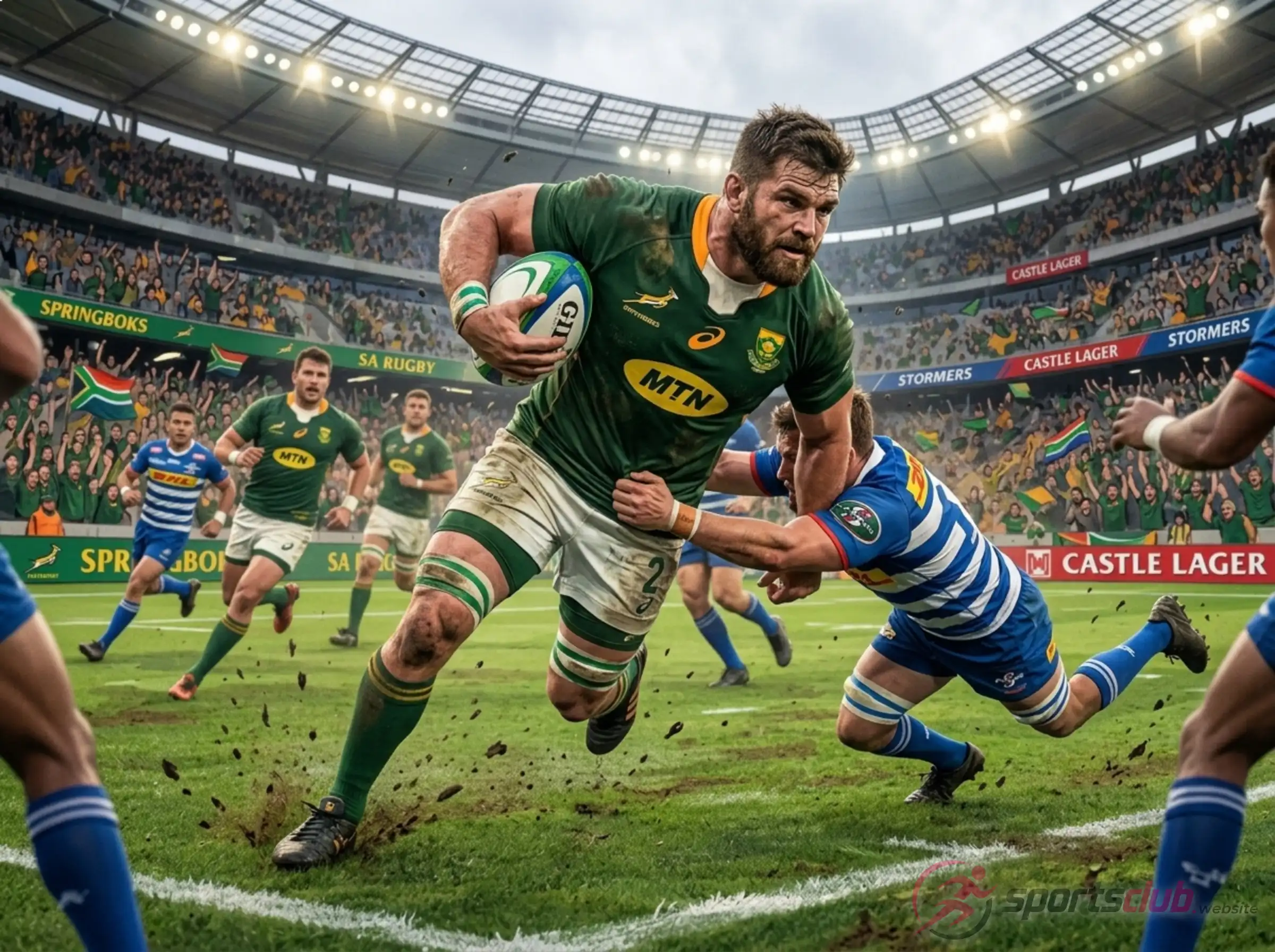
9. Major Honors & Achievements
- World Rugby Men’s 15s Player of the Year — 2025 (first hooker to win since Keith Wood in 2001)
- SA Rugby Men’s Player of the Year — 2025 and 2017 (two-time winner)
- Rugby World Cup winner — 2019 and 2023
- SA Rugby Young Player of the Year (early career)
- Lions Super Rugby Player of the Year, Supporters’ Player of the Year, Players’ Player of the Year, Most Valuable Player of the Year — all in the same 2017 season
- Top try-scoring forward in Super Rugby in a Lions season (12 tries)
- Multiple prior World Rugby Player of the Year shortlist appearances (including 2018)
His 2025 double — the World Rugby award alongside the domestic SA Rugby prize — capped a year in which the Springboks won 11 of 13 Tests, successfully defended the Rugby Championship title, and were named World Rugby’s Team of the Year, with Rassie Erasmus taking Coach of the Year. Marx started 11 Tests in 2025 and scored four tries in the Rugby Championship alone, including a second-half brace against Argentina at Twickenham in October that helped South Africa complete a come-from-behind win and secure back-to-back Rugby Championship titles.
10. Rivalries & Notable Match-Ups
Rugby doesn’t generate the kind of individual, headline-driven rivalries common in combat sports, and it would be inaccurate to invent a personal feud where none has been publicly documented. What can be said accurately is that Marx’s career has been defined by two recurring, well-documented dynamics:
Marx vs. Mbonambi (internal competition): For most of the past decade, South Africa’s hooking department has effectively been a two-horse race between Marx and Bongi Mbonambi, with Rassie Erasmus and his coaching staff alternating the pair depending on form, fitness, and game plan. Both were part of both World Cup-winning squads, and both are regarded among the finest hookers of their generation — a rare case of genuine strength-in-depth at a specialist position.
Marx vs. the All Blacks front row: Test matches between South Africa and New Zealand have repeatedly featured Marx in direct combat with New Zealand’s hooking stocks (across various players over the years), and his breakdown work has frequently been highlighted by broadcasters as a deciding factor in tight Rugby Championship contests, including South Africa’s narrow 36–34 win over the All Blacks in Wellington in 2018, where Marx was among four Springbok try-scorers.
11. Malcolm Marx Injuries & Setbacks
Marx’s career has been shaped as much by resilience through injury as by his skill. Three moments stand out:
- The 2023 Rugby World Cup knee injury — suffered in training after coming off against Scotland, ending his tournament and reportedly requiring a lengthy recovery.
- A Super Rugby-era injury layoff during his time with the Lions that interrupted his early representative momentum.
- Multiple shorter fitness setbacks across his time in Japan and with the Springboks that have periodically kept him and Mbonambi both sidelined from squads simultaneously, forcing the Springbok coaching staff to develop hooking depth elsewhere.
What’s been publicly consistent, according to South African rugby media coverage, is Marx’s pattern of returning from each setback to reclaim his place — a big part of why he’s discussed as a serious contender for a place in South Africa’s squad for the 2027 Rugby World Cup in Australia, even as he heads toward his mid-thirties.
12. Off-the-Field Life
Malcolm Marx is married to Kirsten, and the couple have two children: a daughter, Kenna, and a son, Jake Justin, born in June 2024. Public reporting on Marx’s personal life has generally centered on his standing as a senior figure within the Springbok squad — he is frequently described alongside players like Siya Kolisi, Eben Etzebeth, and Bongi Mbonambi as part of the team’s core leadership group, despite being based abroad for his club career.
Basing himself in Japan since 2020 has made him something of a long-distance commuter within Springbok rugby, flying in for international windows while building a domestic career and family life in Japan. That dual existence — elite professional in one country, Test regular in another — has become one of the more distinctive features of his profile compared to teammates based in South Africa, Europe, or elsewhere.
 13. Malcolm Marx Endorsements, Brand & Public Profile And Net Worth
Marx’s commercial profile has grown alongside his on-field standing, particularly following his 2025 World Rugby Player of the Year award, which significantly raised his global visibility. However, specific, current sponsorship contracts and any net-worth estimate are not the kind of information that can be reliably verified through official or reputable sources at the level of precision this section would ideally offer — figures circulating online for athlete net worth are frequently unsourced estimates rather than confirmed financial data. Rather than present invented numbers as fact, it’s more accurate to say: Marx is widely regarded within South African and Japanese rugby media as one of the sport’s most recognizable current forwards, with a public profile bolstered by his club role in Japan, his Springbok leadership standing, and his 2025 individual honors.
- One site estimates $2 million (as of 2025), with an “annual rugby salary around $700,000.”
- Another site says $3 million (as of 2022).
- A third gives a vague range of $1–5 million, citing “Wikipedia, Forbes, IMDb & various online resources” — none of which actually publish athlete net worth figures like this.
- A fourth is a social-media-influence “net worth” calculator based on follower counts, which isn’t a financial estimate at all.
None of these are primary sources. They’re the standard tier of net-worth aggregator sites that generate a plausible-sounding number for any public figure, usually without any actual salary data, contract disclosure, or financial filing behind it — rugby doesn’t publish player salaries the way some sports do, and neither the Springboks, SA Rugby, nor Kubota Spears disclose Marx’s earnings publicly. So every number floating around is really just a guess dressed up as a fact.
14. Malcolm Marx Facts for Fans
- He was part of the schoolboy trio at King Edward VII School nicknamed the “Three Musketeers.”
- He originally played flanker, not hooker, until a coaching suggestion changed his career path.
- His Super Rugby debut came on 5 April 2014, against the Crusaders.
- He was the top try-scoring forward in a Super Rugby season with 12 tries for the Lions.
- He won four different Lions individual awards in the same 2017 season.
- His first Test try came against France in June 2017.
- He came off the bench to help finish the 2019 World Cup final after Bongi Mbonambi’s injury.
- He’s a two-time Rugby World Cup champion (2019, 2023).
- His 2023 World Cup ended early due to a knee injury against Scotland.
- He’s played his club rugby in Japan since 2020, currently with Kubota Spears.
- He became the first hooker since 2001 to win World Rugby Player of the Year.
- He’s a father of two, with children Kenna and Jake Justin.
- As of mid-2026, he’s closing in on his 90th Springbok cap.
15. Malcolm Marx Comparison with Peers
Rather than presenting a table of precise stat-for-stat figures I can’t fully verify across multiple international databases (which often disagree by a few caps or tries, as noted in Section 6), here is an honest, source-grounded comparison:
| Player | Country | Position | Notable Standing (as publicly reported) |
|---|---|---|---|
| Malcolm Marx | South Africa | Hooker | ~89 caps (mid-2026); two-time World Cup winner; 2025 World Rugby Player of the Year |
| Bongi Mbonambi | South Africa | Hooker | Over 80 caps as of late 2025; two-time World Cup winner alongside Marx; long-time Springbok co-starter at hooker |
Both men have been central to South Africa’s back-to-back World Cup triumphs, and both are regularly cited by South African rugby media as among the finest hookers their country has produced. A wider global comparison against hookers like New Zealand’s or England’s current starters would require verified up-to-date cap and try data for each, which this article doesn’t have confirmed sourcing for — so it’s been left out rather than approximated.
16. Legacy & Impact on Rugby
Even before the 2025 World Rugby award, Marx had already reshaped expectations of what a modern hooker could do — a forward athletic enough to have played flanker, redeployed into rugby’s most technically demanding front-row position, and turned into arguably the position’s most complete practitioner of his era. His breakdown work in particular has influenced how South African and other coaching staffs think about selecting hookers: not purely as scrummaging and lineout specialists, but as genuine ball-players and turnover threats in open play.
His decision to relocate to Japan in 2020 also became something of a template for other South African players navigating the financial upheaval of the pandemic era — proof that a Springbok could build a serious club career overseas without sacrificing Test status, provided form and fitness held up.
17. What’s Next — Current Season/Career Outlook
As of mid-2026, Marx remains firmly entrenched as South Africa’s first-choice hooker under Rassie Erasmus, closing in on his 90th Test cap and continuing to represent Kubota Spears in Japan under a contract that runs through 2027. With the next Rugby World Cup scheduled for Australia in 2027, South African rugby media coverage has repeatedly named Marx as one of the players most likely to anchor the Springboks’ hooking stocks into that tournament, injuries permitting, even as questions grow about long-term succession planning at the position given the age profile of both Marx and Mbonambi.
18. Frequently Asked Question About Malcolm Marx
1. What is Malcolm Marx’s full name?
His full name is Malcolm Justin Marx.
2. When was Malcolm Marx born?
He was born on 13 July 1994 in Germiston, South Africa.
3. What position does Malcolm Marx play?
He plays hooker, though he started his career as a flanker.
4. Which club does Malcolm Marx currently play for?
He plays for Kubota Spears Funabashi Tokyo-Bay in Japan Rugby League One, part of his broader Malcolm Marx club career that also included the Lions and NTT Shining Arcs.
5. How many Rugby World Cups has Malcolm Marx won?
He’s won two, in 2019 and 2023, both times as part of the Springboks’ squad — this covers most questions about Malcolm Marx Rugby World Cup history.
6. How many international caps does Malcolm Marx have?
As of the Springboks’ Test against Wales in July 2026, he was closing in on his 89th cap — for the latest Malcolm Marx international caps figure, check World Rugby’s official statistics.
7. Did Malcolm Marx win World Rugby Player of the Year?
Yes — he won the 2025 World Rugby Men’s 15s Player of the Year award, becoming the first hooker to do so since 2001.
8. Why did Malcolm Marx miss most of the 2023 Rugby World Cup?
He suffered a knee injury in training after being substituted against Scotland, which ruled him out for the rest of the tournament.
9. Is Malcolm Marx married?
Yes, he is married to Kirsten, and they have two children, Kenna and Jake Justin.
10. How many tries has Malcolm Marx scored for South Africa?
Public sources place his Test try tally in the mid-to-high 20s as of late 2025, though exact figures vary slightly between statistical databases — see Section 6 for detail.

19. Sources & Reference
Springboks (SA Rugby) – [Source] , World Rugby – [Source] , Wikipedia – [Source] , Ultimate Rugby -[Source] , Rugby365 – [Source] , BBC Sport – [Source] , Rugby World -[Source] , IOL Sport – [Source] , The Citizen – [Source] , RugbyPass – [Source] , SA Rugby Magazine – [Source] , SABC Sport – [Source]