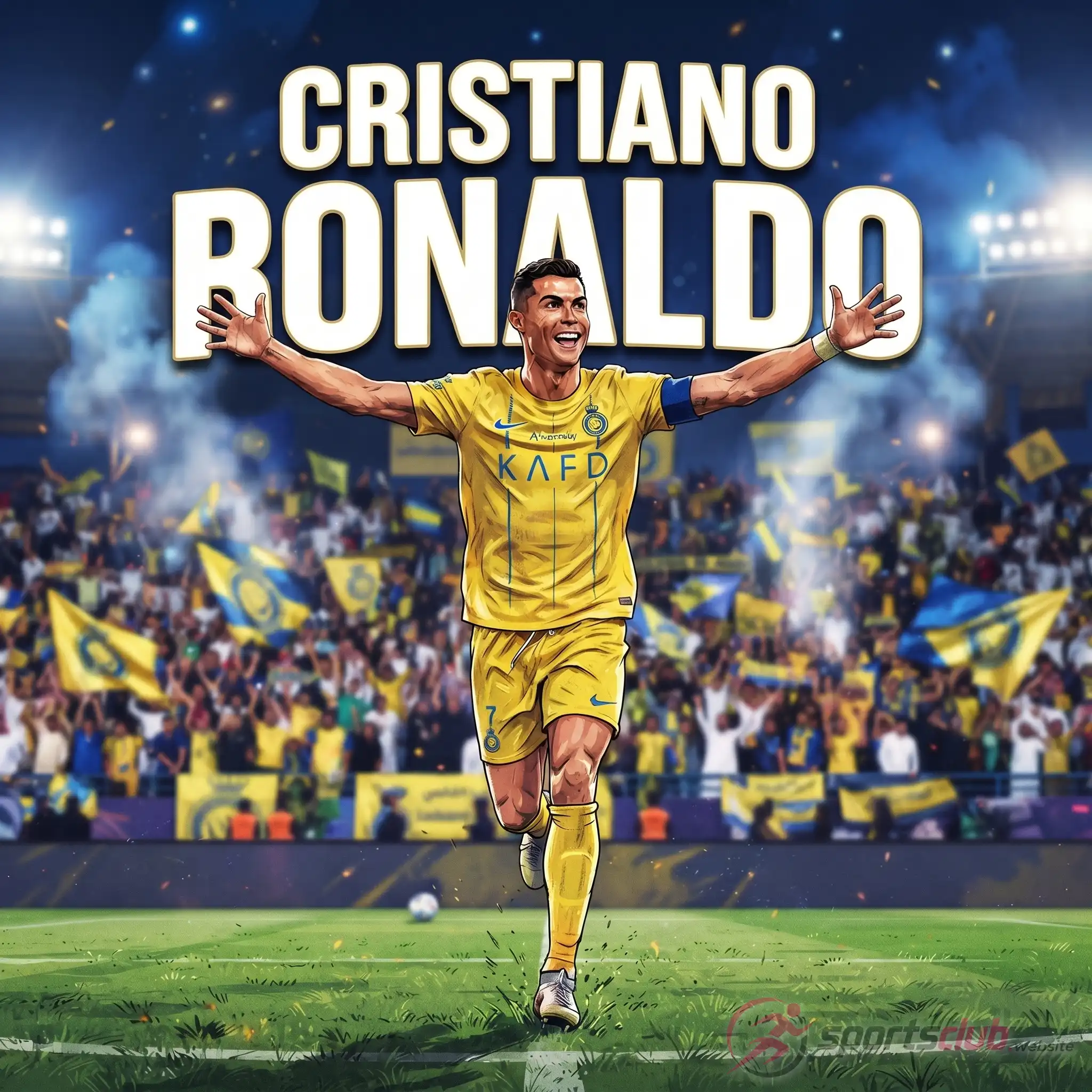
1. Cristiano Ronaldo Profile
| Category | Detail |
|---|---|
| Full Name | Cristiano Ronaldo dos Santos Aveiro |
| Date of Birth | February 5, 1985 |
| Birthplace | Funchal, Madeira, Portugal |
| Nationality | Portuguese |
| Current Club | Al Nassr FC (Saudi Pro League) |
| Jersey Number | 7 |
| Position | Forward |
| Height | 1.87 m (6 ft 2 in) |
| National Team Caps | 233 |
| International Goals | 146 (men’s all-time record) |
| Career Club Goals | 828+ |
| Total Career Goals | 976+ (as of mid-2026) |
| Ballon d’Or Wins | 5 (2008, 2013, 2014, 2016, 2017) |
| UEFA Champions League Titles | 5 |
| Major International Titles | UEFA Euro 2016, UEFA Nations League 2019 & 2024 |
2. Introduction: Who is Cristiano Ronaldo?
Few names in world sport carry the instant recognition of Cristiano Ronaldo. Across more than two decades at the very top of the game, the Portuguese forward has rewritten the record books so many times that football statisticians have had to build entirely new categories just to keep track of him. This Cristiano Ronaldo biography walks through the milestones of a career that began on the sun-baked pitches of Madeira and has since spanned Lisbon, Manchester, Madrid, Turin, and Riyadh — five clubs, four countries, and one of the most consistent goal-scoring records the sport has ever produced.
What makes this Cristiano Ronaldo story remarkable is not just the trophies, though there are more than thirty of them, but the sheer longevity behind the numbers. In the summer of 2026, at 41 years old, Ronaldo was still lacing up his boots for Al Nassr and captaining Portugal at a sixth World Cup — becoming the first men’s player in history to score at six different editions of the tournament. That milestone alone would be enough to secure his place in the sport’s folklore, but it sits alongside dozens of other records: most Champions League goals ever scored, most international goals ever scored by a man, most Ballon d’Or nominations, and one of the longest sustained primes in the history of professional football.
Whether you’re searching for Cristiano Ronaldo facts, Cristiano Ronaldo stats, or a full breakdown of his Cristiano Ronaldo club career, this guide brings everything together in one place, verified against the latest reporting available as of 2026. We’ll cover his childhood in Madeira, his rapid rise through Sporting CP’s academy, his transformative years under Sir Alex Ferguson at Manchester United, his record-breaking spell at Real Madrid, his time in Turin with Juventus, his emotional second stint back at Old Trafford, and his current chapter with Al Nassr in Saudi Arabia. We’ll also dig into his international career with Portugal, his rivalry with Lionel Messi, his business empire, and where his story stands as the 2026–27 season approaches.
From a skinny teenager who left home at 12 to chase a professional contract, to a global icon nearing a billion social media followers, Ronaldo’s journey is as much about relentless self-improvement as it is about talent. Read on for the full picture — his childhood, his breakthrough, his Cristiano Ronaldo transfer history, his World Cup heartbreaks and triumphs, and where his story stands today.
3. Cristiano Ronaldo Early Life & Background
3.1 Birth and Family
Cristiano Ronaldo dos Santos Aveiro was born on February 5, 1985, in the Santo António parish of Funchal, the capital of Portugal’s Madeira Islands, an autonomous archipelago in the Atlantic Ocean roughly 500 miles off the coast of mainland Portugal. He was the youngest of four children born to José Dinis Aveiro and Maria Dolores dos Santos Aveiro, joining older siblings Hugo, Elma, and Liliana Cátia in a household that, by all accounts, knew significant financial hardship during his early years.
His father worked as an equipment manager, or “kit man,” for a modest local football club, Andorinha, a role that placed young Cristiano in and around football fields from an age before he could properly kick a ball with control. His mother took on work as a cook and cleaner to help make ends meet in a household that, according to widely reported accounts of his upbringing, sometimes struggled to put enough food on the table. This backdrop of modest means is frequently cited as a formative influence on the intense work ethic that would later define his professional career — a sense, instilled early, that nothing would be handed to him and that opportunity had to be earned through relentless effort.
3.2 A Childhood Built Around Football
The Ronaldo household was steeped in football from the start. His father’s job around Andorinha’s grounds meant young Cristiano spent much of his early childhood kicking a ball on the touchline and in the narrow, hilly streets of his neighborhood in Funchal. According to accounts from those years, he was so devoted to the sport that teachers reportedly struggled to keep his attention on schoolwork — a trait that eventually led him to leave formal education behind entirely so he could pursue football full-time, a decision that would have been almost unthinkable for most families but one that his parents ultimately supported given how singular his focus and talent already appeared.
By his early childhood years, Ronaldo was already playing organized football for a local amateur side before moving to Nacional, one of Madeira’s more established clubs, where his performances began to draw attention beyond the island for the first time. Even at this young age, coaches who worked with him have described a player who combined raw pace and technical ability with a competitiveness that stood out even among other promising youth players — a refusal to lose, whether in a competitive match or an informal kickabout.
3.3 Leaving Madeira
It didn’t take long for his talent to attract attention well beyond the island. Madeira, for all its footballing tradition, offered a limited pathway to the professional game compared to the academies of mainland Portugal, and it became increasingly clear that if Ronaldo was going to fulfill his potential, he would need to leave home.
Did You Know? Ronaldo’s middle name, “Ronaldo,” was reportedly chosen by his parents in tribute to former U.S. President Ronald Reagan, a favorite actor of his father’s.
4. Youth Academy & Breakthrough
4.1 Joining Sporting CP
At just 12 years old, Ronaldo left Madeira for mainland Portugal to join the youth academy of Sporting Clube de Portugal (Sporting CP) in Lisbon — a move that meant leaving his family behind at an age most children are still deeply reliant on home support. This was not a small transition. He went from a tight-knit island community, where extended family and neighbors were a constant presence, to a residential academy dormitory hundreds of miles away, surrounded by unfamiliar faces and an accent and rhythm of life very different from what he had known in Funchal.
The adjustment was difficult; homesickness and the culture shock of leaving an island community for a Lisbon academy dormitory tested his resolve early, and there are widely reported accounts of a young Ronaldo struggling emotionally in his first months at the academy, missing his mother and considering whether the sacrifice was worth it. But his performances on the pitch never wavered, and the coaching staff at Sporting quickly recognized that they had a special talent developing in their system.
4.2 Rising Through the Ranks
Ronaldo progressed rapidly through Sporting’s various youth age groups, regularly playing above his own age bracket due to his physical and technical development outpacing his peers. Coaches within the club’s famous academy — one that has also produced other notable Portuguese internationals over the years — noted his combination of two-footed ability, explosive pace, and an almost obsessive desire to add new skills and tricks to his game during training sessions that extended well beyond what was required of him.
Rising quickly through Sporting’s youth ranks, Ronaldo made his senior team debut in 2002 as a 17-year-old, scoring twice on his first start — an eye-catching beginning that immediately signaled he was ready for first-team football far sooner than most academy graduates.
4.3 The Manchester United Trial by Fire
His breakout moment on the international stage came in August 2003, in a pre-season friendly between Sporting CP and Manchester United, held to mark the opening of Sporting’s new stadium, the Estádio José Alvalade. Ronaldo gave United’s experienced defenders a torrid afternoon, repeatedly beating his marker with a blend of dribbling, acceleration, and unpredictable movement that left seasoned Premier League professionals struggling to contain him.
By full time, several United players — including club captain Roy Keane — reportedly urged manager Sir Alex Ferguson to sign him immediately, recognizing that they had just witnessed something rare even in the context of a routine pre-season fixture. Ferguson, already aware of Ronaldo through his scouting network, needed little further convincing. Within weeks, Manchester United had completed the transfer, and Ronaldo’s career at the highest level of European football had begun.
4.4 A Symbolic Shirt Number
Did You Know? Ronaldo was given Manchester United’s iconic number 7 shirt as a teenager — a number previously worn by club legends George Best, Eric Cantona, and David Beckham. The decision to hand a largely untested 18-year-old such a historically significant number was, at the time, seen as a considerable statement of faith from Ferguson, and it placed an early spotlight of expectation on Ronaldo’s shoulders that he would spend the next several years working to justify.
5. Cristiano Ronaldo Club Career Timeline
| Club | Years | Appearances | Goals | Notable Transfer Fee |
|---|---|---|---|---|
| Sporting CP | 2002–2003 | 31 | 5 | Youth product |
| Manchester United | 2003–2009 | 292 | 118 | ~£12.24 million (2003) |
| Real Madrid | 2009–2018 | 438 | 450 | ~€94 million (world record, 2009) |
| Juventus | 2018–2021 | 134 | 101 | ~€100 million (2018) |
| Manchester United (2nd spell) | 2021–2022 | 54 | 27 | Free transfer |
| Al Nassr | 2023–present | 100+ | 90+ | Free transfer (Jan. 2023) |
5.1 Manchester United — The Formative Years (2003–2009)
Ronaldo’s first spell at Manchester United (2003–2009) saw him evolve from a flashy, trick-heavy winger into a genuine goal-scoring threat. In his early seasons, his game was defined by step-overs, dazzling footwork, and a tendency to attempt more dribbles than any other player in the league, which occasionally drew criticism from pundits who felt he was more interested in showmanship than end product. Ferguson, however, saw the raw materials of a complete forward and worked patiently with Ronaldo to add end product and defensive discipline to his game.
By the 2006–07 and 2007–08 seasons, that patience paid off spectacularly. Ronaldo developed into arguably the most dangerous attacking player in Europe, combining searing pace with genuine goal-scoring instinct and aerial power that belied his slender frame. The 2007–08 campaign stands out as the definitive breakthrough year of his career, culminating in the 2008 UEFA Champions League title — won on penalties against Chelsea in Moscow, with Ronaldo scoring United’s opening goal in the final with a trademark header — and his first Ballon d’Or, awarded at the end of that calendar year in recognition of his 42-goal season across all competitions.
By the time he departed Old Trafford in 2009, Ronaldo had won three Premier League titles, one Champions League, and established himself as one of the most feared attacking players on the planet.
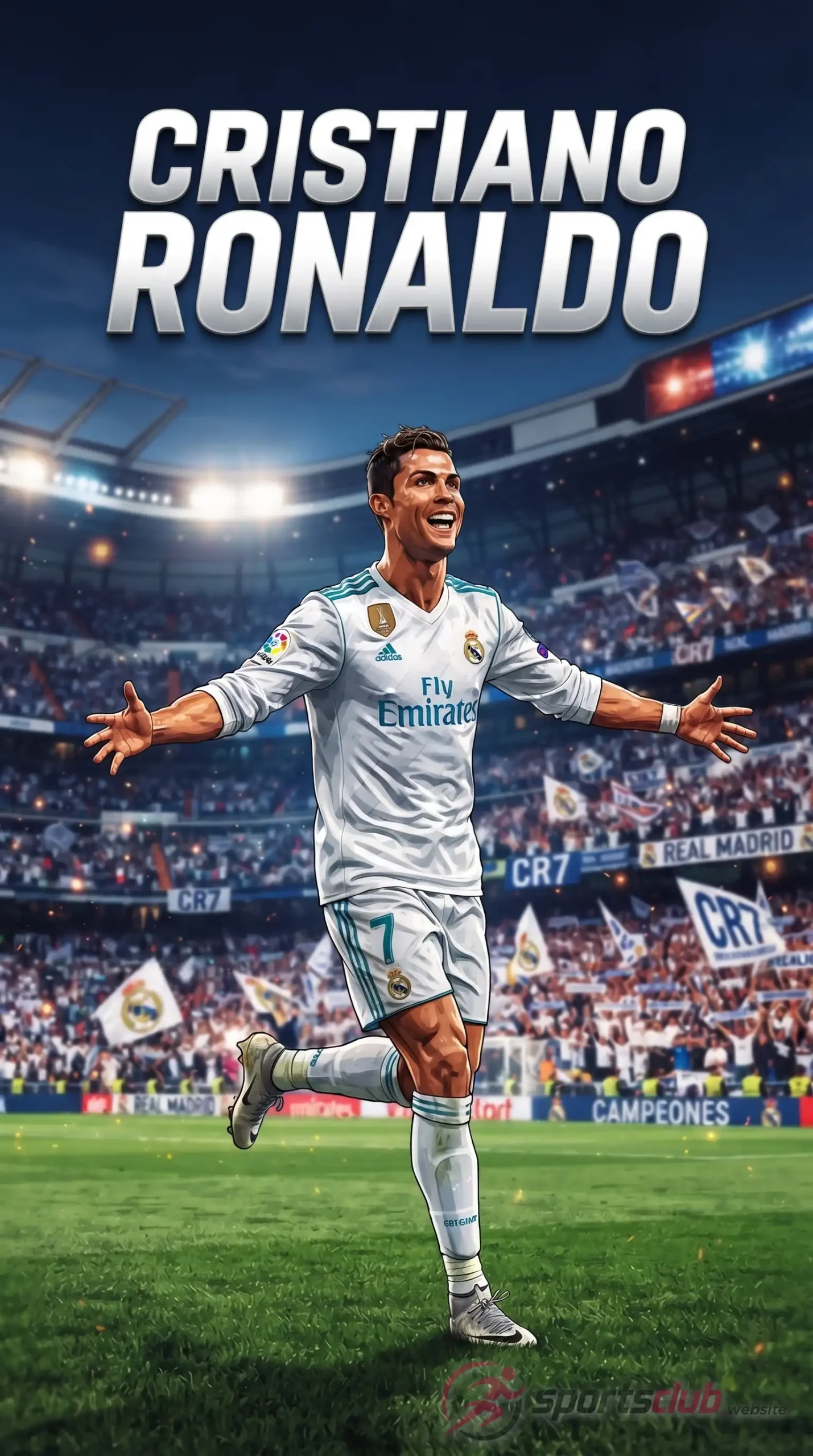
5.2 Real Madrid — The Golden Era (2009–2018)
His 2009 move to Real Madrid shattered the world transfer record at the time, with a fee reported at roughly €94 million, surpassing the previous record set by his new club’s own signing of Kaká earlier that same summer. The move placed enormous pressure on Ronaldo to deliver immediately in one of the most demanding footballing environments in the world, at a club with a supporter base and media culture that offers little patience for underperformance.
He answered that pressure in emphatic fashion. Over nine seasons in Madrid, Ronaldo opened the door to the most prolific scoring stretch of his career — 450 goals in 438 appearances, a rate that remains almost without precedent for a nine-season span at one of the sport’s most demanding clubs. His statistical peak arrived in the 2014–15 season, when he scored 61 goals in 54 appearances across all competitions, a tally still regarded by many analysts as one of the most remarkable single-season outputs in modern football history.
During his time at the Santiago Bernabéu, Ronaldo helped Real Madrid win four UEFA Champions League titles, including a run of three consecutive triumphs between 2016 and 2018 that cemented the club’s status as the dominant force in European football during that period. He also won two La Liga titles, multiple domestic cups, and several FIFA Club World Cup titles, while personally claiming four of his five career Ballon d’Or awards during his Madrid years. By the time he left, he had become the club’s all-time leading goal scorer, a record that still stands.
5.3 Juventus — A New Challenge in Italy (2018–2021)
The switch to Juventus in the summer of 2018, for a fee in the region of €100 million, surprised much of the football world, coming as it did while Ronaldo was still performing at an elite level in Spain. The move was widely interpreted as both a fresh personal challenge and a significant commercial and sporting statement by Juventus, which had long sought to reassert itself at the top of European football after years of Champions League near-misses.
In Turin, Ronaldo continued to perform at an elite level, adapting his game further to accommodate a more physically demanding league and a squad built somewhat differently than the ones he had played in previously. He helped Juventus win two Serie A titles in his three seasons with the club and maintained his remarkable individual goal-scoring consistency, including winning the Serie A Golden Boot in the 2019–20 season. However, the ultimate goal of delivering a Champions League title to Juventus — something the club had craved for decades — remained elusive during his tenure, and this is often cited as the one disappointment of an otherwise successful spell in Italy.
5.4 Return to Manchester United (2021–2022)
A sentimental return to Manchester United in the summer of 2021 was met with enormous excitement from supporters, who welcomed back a player who had left as a 24-year-old superstar and returned as a 36-year-old veteran with a wealth of additional silverware and experience. His first months back at Old Trafford produced moments of vintage brilliance, including a memorable brace on his second debut against Newcastle United.
However, the broader team context around him had shifted considerably since his first spell, and Manchester United struggled collectively during this period, failing to challenge for major honors despite Ronaldo’s individual goal-scoring contributions. That second United chapter ended acrimoniously in late 2022 following a highly publicized fallout with the club’s management, which resulted in the termination of his contract by mutual agreement before the end of the 2022–23 season.
5.5 Al Nassr and a New Frontier in Saudi Arabia (2023–Present)
Following his departure from Manchester United, Ronaldo signed with Saudi Arabian side Al Nassr in January 2023 on a free transfer — a move that reshaped the profile of the Saudi Pro League and paved the way for several other high-profile players and managers to follow him there in the years since. His arrival is widely credited with significantly raising the league’s global visibility, commercial value, and broadcast reach almost overnight.
Ronaldo has continued to score prolifically in Saudi Arabia, leading the league in scoring in multiple seasons since his arrival. In 2025, he signed a contract extension keeping him at Al Nassr through 2027, publicly reaffirming his commitment to the club and dismissing speculation about a possible departure. That commitment was rewarded in the 2025–26 season, when Al Nassr finally won its long-sought Saudi Pro League title with Ronaldo as a central figure in the squad — the first domestic league title of his Saudi Arabian chapter, and by some measures the missing piece in an otherwise decorated third act of his career.
6. Cristiano Ronaldo International Career & Major Tournaments
| Tournament | Year | Result | Ronaldo’s Role |
|---|---|---|---|
| UEFA European Championship | 2004 | Runner-up | Squad member |
| FIFA World Cup | 2006 | 4th place | Squad member |
| UEFA European Championship | 2008 | Quarter-final | Key player |
| FIFA World Cup | 2010 | Round of 16 | Key player |
| UEFA European Championship | 2012 | Semi-final | Captain |
| FIFA World Cup | 2014 | Group stage | Captain |
| UEFA European Championship | 2016 | Champions | Captain |
| FIFA World Cup | 2018 | Round of 16 | Captain |
| UEFA Nations League | 2019 | Champions | Captain |
| FIFA World Cup | 2022 | Quarter-final | Captain |
| UEFA Nations League | 2024 | Champions | Captain |
| FIFA World Cup | 2026 | Round of 16 | Captain |
6.1 Early Tournaments and a Home Heartbreak
Ronaldo made his senior Portugal debut in 2003 as an 18-year-old, and his first major tournament arrived the following summer when Portugal hosted the 2004 UEFA European Championship. The tournament proved to be a bittersweet introduction to major international football: Portugal advanced all the way to the final on home soil, only to lose to a Greek side that had defied expectations throughout the competition. It was a formative disappointment for a young Ronaldo, who was seen in tears on the pitch after the final whistle.
His first World Cup arrived in 2006 in Germany, where Portugal reached the semi-finals before losing to eventual runners-up France, finishing fourth overall after a further defeat in the third-place playoff.
6.2 Assuming the Captaincy
As Ronaldo’s influence within the squad grew through the following decade, he was eventually handed the Portugal captaincy, a role he embraced fully both on and off the pitch. The 2014 World Cup in Brazil proved difficult, with Portugal eliminated at the group stage despite Ronaldo’s individual efforts, but the disappointment set the stage for one of the defining moments of his international career two years later.
6.3 Euro 2016 — Portugal’s First Major Trophy
The 2016 European Championship in France produced the signature achievement of Ronaldo’s international career. Portugal navigated a difficult tournament path, advancing as one of the best third-placed group teams before grinding through the knockout stages. In the final against host nation France, Ronaldo suffered a knee injury early in the match and was forced off in tears, unable to continue — a moment that appeared, in the immediate aftermath, to be a cruel end to his tournament. Yet he remained on the touchline throughout extra time, visibly directing and encouraging his teammates from the sideline, and Portugal ultimately won the match to claim the country’s first-ever major international trophy. The image of an injured Ronaldo celebrating wildly on the sideline as the final whistle blew has become one of the most iconic moments of his career, arguably more emotionally resonant than many of his individual goal-scoring achievements.
6.4 Later World Cups and Continued Success
Portugal’s 2018 World Cup campaign ended in the round of 16, though Ronaldo scored a memorable hat-trick against Spain in the group stage that is still regarded as one of the great individual World Cup performances of the modern era. The team went on to win the inaugural UEFA Nations League in 2019, adding a second major trophy to Ronaldo’s international collection, hosted on home soil in Portugal.
The 2022 World Cup in Qatar saw Portugal reach the quarter-finals before a defeat to Morocco, a tournament complicated by Ronaldo’s contentious relationship with his club situation at the time and questions over his role within the national team setup. Despite that turbulence, he remained a central figure for Portugal, and the team went on to win a second UEFA Nations League title in 2024.
6.5 The 2026 World Cup — A Historic Farewell
The 2026 FIFA World Cup, jointly hosted across North America, marked a historic milestone for Ronaldo: he became the first men’s player ever to score in six different World Cup tournaments, a record that had eluded every other player in the history of the competition. He opened his account with a brace against Uzbekistan in the group stage before adding a penalty against Croatia in the round of 32, taking his career World Cup goal tally to 11 goals across 27 appearances and six tournaments — among the most appearances ever recorded by an outfield player at the men’s World Cup.
Portugal’s run ultimately ended with a 1–0 defeat to eventual champions Spain in the round of 16, a result decided by a stoppage-time winning goal. After the match, Ronaldo confirmed — in paraphrased comments to reporters — that the tournament had been his last World Cup appearance, expressing sadness at the manner of the exit while stating that he had given everything and could leave with a clear conscience. He stopped short of confirming a full international retirement, saying he did not want to make decisions in an emotional moment and that any future call would come after time spent reflecting with his family.
Did You Know? Ronaldo is among the most-capped outfield players in men’s World Cup history, having featured in 27 matches across six tournaments spanning two decades, from his debut appearance in 2006 to his farewell in 2026.
7. Cristiano Ronaldo Playing Style & Signature Skills
7.1 An Evolving Game
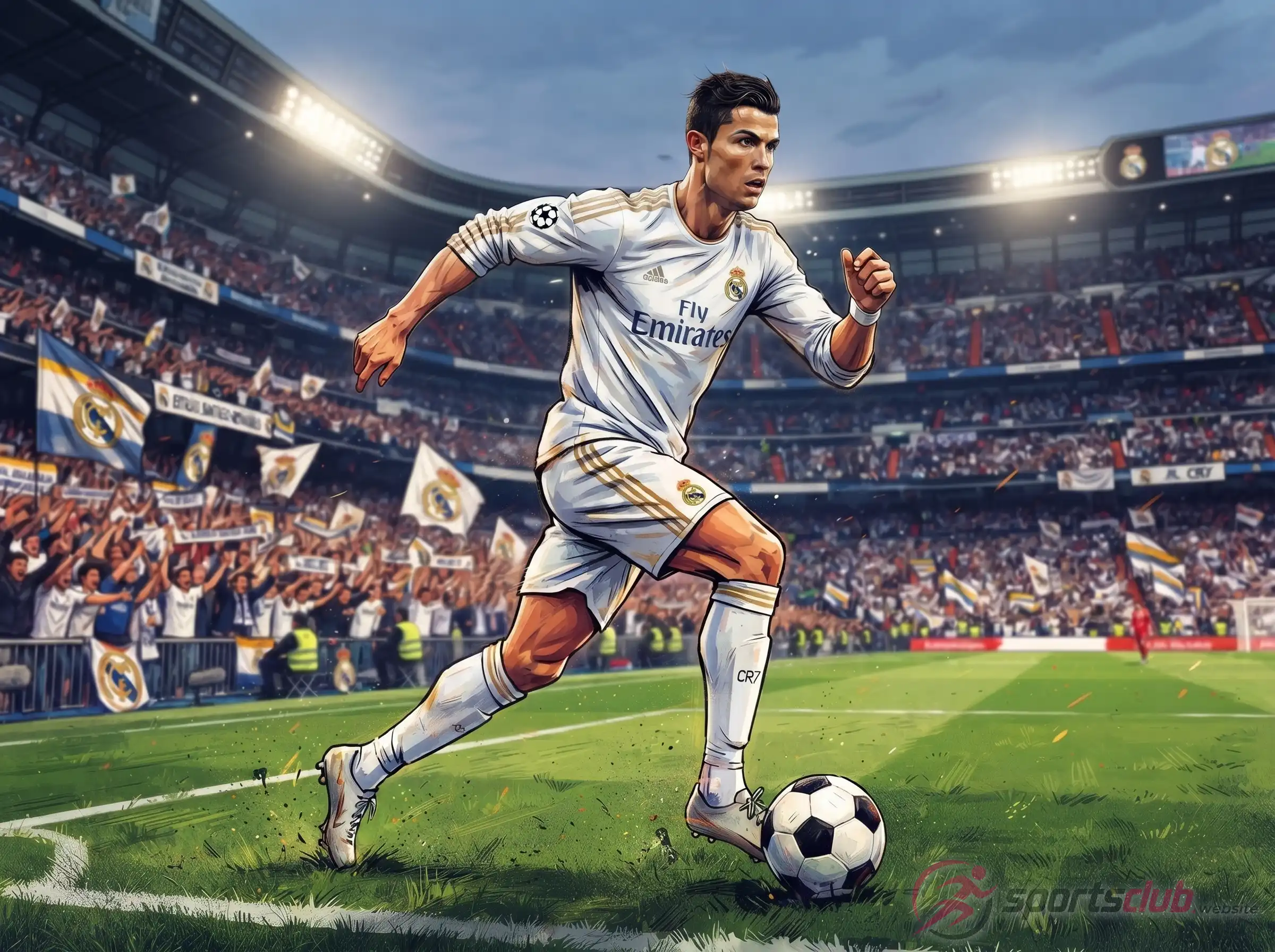
Ronaldo’s game has evolved dramatically across his career, arguably more than almost any other elite player of his generation. As a young winger at Sporting and early Manchester United, he was known for elaborate dribbling, step-overs, and pace down the flank, often deployed as a wide player who cut inside onto his stronger right foot. Under Ferguson’s guidance at United, he transformed into a more disciplined, clinical operator, gradually shifting toward a central striking role that maximized his aerial power and finishing instinct — a positional evolution that continued and deepened during his years at Real Madrid, where he became primarily a penalty-box predator rather than a wide creator.
7.2 Core Physical and Technical Attributes
Several traits have defined his game throughout the different eras of his career:
- Elite aerial ability — his vertical leap, hang time, and timing in the air have made him one of the most dangerous headers of the ball in modern football, a remarkable trait for a player who is not exceptionally tall by center-forward standards.
- Two-footed finishing — equally comfortable scoring with his left or right foot, a rarity among elite forwards that has made him far harder to defend against in the penalty area.
- The “knuckleball” free kick — a low-spin striking technique that makes his shot swerve and dip unpredictably in flight, a signature move that opposing goalkeepers have spent years trying to prepare for.
- Explosive acceleration — even into his late 30s, Ronaldo maintained rare sprint speed for a player of his age, a physical trait widely credited to his exceptional conditioning regimen.
- Positional intelligence — his ability to read the timing of crosses and time his runs into the box has become, if anything, sharper as his straight-line pace has naturally declined with age.
7.3 The Conditioning Behind the Longevity
Perhaps the single most discussed aspect of Ronaldo’s playing style in recent years is not a technical skill at all, but his relentless off-season and in-season conditioning — widely credited as one of the most disciplined professional athletes in any sport, with a training, nutrition, and recovery regimen often cited by sports scientists and fellow professionals as a benchmark for athletic longevity. Reports over the years have described everything from cryotherapy and hyperbaric recovery chambers to strict sleep management and highly personalized nutrition plans, all aimed at extending his physical peak well beyond what is typical for a professional footballer.
This combination of raw athleticism and obsessive self-maintenance is a major reason Cristiano Ronaldo stats remain competitive with players half his age, even in his forties, and it is a significant part of why he was able to remain a first-choice starter for both club and country deep into his 41st year.
8. Goals & Assists by Season (Selected Career Highlights)
| Season | Club | Goals | Assists | Competition Highlights |
|---|---|---|---|---|
| 2006–07 | Manchester United | 23 | 15 | Premier League title |
| 2007–08 | Manchester United | 42 | 12 | Champions League + Premier League double |
| 2008–09 | Manchester United | 26 | 10 | Premier League title |
| 2010–11 | Real Madrid | 53 | 15 | Copa del Rey |
| 2011–12 | Real Madrid | 60 | 21 | La Liga title, Pichichi winner |
| 2013–14 | Real Madrid | 51 | 15 | Champions League title (“La Décima”) |
| 2014–15 | Real Madrid | 61 | 22 | Career-best single season for goals |
| 2016–17 | Real Madrid | 42 | 8 | Champions League + La Liga double |
| 2017–18 | Real Madrid | 44 | 8 | Champions League title (3rd consecutive) |
| 2019–20 | Juventus | 37 | 7 | Serie A title, Golden Boot (Serie A) |
| 2020–21 | Juventus | 36 | 7 | Coppa Italia |
| 2022–23 | Man United / Al Nassr | 18 | 3 | Mid-season transfer |
| 2023–24 | Al Nassr | 44 | 12 | Saudi Pro League top scorer |
| 2024–25 | Al Nassr | 35 | 6 | Saudi Pro League top scorer |
| 2025–26 | Al Nassr | 30 | 5 | Saudi Pro League title win |
His 2014–15 campaign at Real Madrid, with 61 goals in 54 appearances across all competitions, is widely regarded as the statistical peak of his club career, though his 2011–12 and 2013–14 seasons were similarly extraordinary in different competitive contexts. Even well into his Saudi Arabian chapter, Ronaldo continued to post goal-scoring numbers that would represent career-best seasons for most professional strikers, underscoring the unusual nature of his longevity.
9. Major Honors & Achievements of Cristiano Ronaldo
9.1 Individual Awards
- Ballon d’Or: 5 (2008, 2013, 2014, 2016, 2017)
- FIFA World Player / The Best FIFA Men’s Player: Multiple wins across his career
- European Golden Shoe: 4 times (a European record)
- UEFA Men’s Player of the Year: 3 times
- UEFA Champions League all-time top scorer (140+ goals)
- All-time leading scorer for Real Madrid (450 goals)
- All-time leading scorer for the Portugal national team and in men’s international football overall (146 goals)
- UEFA Champions League Best Forward / Best Player honors on multiple occasions
- Premier League Player of the Season and PFA Players’ Player of the Year during his Manchester United years
9.2 Team Honors
- UEFA Champions League: 5 titles (1 with Manchester United, 4 with Real Madrid)
- League titles: 3 Premier League (Manchester United), 2 La Liga (Real Madrid), 2 Serie A (Juventus), 1 Saudi Pro League (Al Nassr)
- UEFA European Championship: 1 (2016, as Portugal captain)
- UEFA Nations League: 2 (2019, 2024)
- FIFA Club World Cup: Multiple titles with Real Madrid
- Domestic cups: Multiple FA Cup, Copa del Rey, and Coppa Italia successes across his English, Spanish, and Italian club spells
Did You Know? Ronaldo is one of only a handful of players in football history to have won league titles in four different countries — England, Spain, Italy, and Saudi Arabia — a testament to his adaptability across different footballing cultures and playing styles.
10. Rivalries & Head-to-Head Battles
10.1 Ronaldo vs. Messi — The Defining Rivalry of a Generation
No discussion of Cristiano Ronaldo stats is complete without addressing his rivalry with Lionel Messi. For over a decade, the two dominated the Ballon d’Or conversation, trading the award back and forth while playing for Spain’s two fiercest domestic rivals — Ronaldo at Real Madrid, Messi at Barcelona. Their head-to-head “El Clásico” battles became appointment viewing across the football world, drawing global audiences unlike almost any other recurring club fixture in the sport’s history, with both players pushing each other to new statistical heights throughout the 2010s.
The debate over which player is objectively “better” has never been definitively settled and likely never will be, largely because the two forwards, despite their overlapping era, offer genuinely different skill sets — Ronaldo’s power, athleticism, and aerial dominance against Messi’s low center of gravity, close control, and vision. What is not in dispute is that their mutual competition elevated both players’ output and profile to levels that may not have been reached in isolation, and their rivalry is widely credited with helping drive football’s global commercial growth throughout the 2010s.
10.2 Domestic Rivalries
Beyond Messi, Ronaldo built notable competitive rivalries at each stop of his career. In England, his Manchester United years coincided with fierce battles against Chelsea and Arsenal for Premier League supremacy. In Spain, beyond the Clásico fixture itself, his Real Madrid tenure featured intense competition with Atlético Madrid, particularly across several dramatic Champions League knockout ties. In Italy, he faced stiff competition from strikers like Zlatan Ibrahimović during overlapping periods in Serie A, with the Swedish forward’s combative personality and similarly prolific scoring record making for a natural on-pitch rivalry.
10.3 The Next Generation
More recently, Ronaldo has found himself measured against a younger generation led by Kylian Mbappé and Erling Haaland, both of whom have cited Ronaldo’s professionalism, work ethic, and scoring habits as influences on their own games. While their statistical primes have not always overlapped directly with Ronaldo’s own peak years, comparisons between the generations remain a constant talking point in football media, with Ronaldo’s longevity often held up as a standard those younger stars are still working to match.
11. Cristiano Ronaldo Injuries & Setbacks
11.1 Notable Physical Setbacks
Despite his longevity, Ronaldo’s career has not been injury-free, and several notable setbacks have punctuated his two-decade career at the top level:
- A serious knee injury during the 2008–09 season at Manchester United that required surgery during the off-season, an early test of his physical resilience at a relatively young age.
- Recurring thigh and hamstring strains during his Real Madrid years, particularly in the mid-2010s, largely managed through careful load management and rotation in later seasons as the club sought to protect its most important asset across a demanding fixture schedule.
- An emotional injury-forced early exit in the Euro 2016 final, where he was substituted off in tears in the first half of the match before Portugal went on to win the tournament without him on the pitch for the decisive stages — one of the most talked-about injury moments of his career precisely because of how it was followed by triumph rather than heartbreak.
- Various minor muscular issues in his late 30s and early 40s, generally managed proactively through rest and rotation given his advancing age and heavy match load across both club and country commitments.
11.2 Managing Age and Fitness
What stands out across Ronaldo’s injury history is less the frequency of setbacks — which is broadly comparable to many elite forwards over a similarly long career — and more his consistent ability to avoid long-term, career-threatening injuries into his fifth decade of life. This is frequently cited by sports scientists and physiotherapists as a case study in athletic longevity, often referenced alongside his conditioning regimen as a template for extending an elite athletic career well past the point where most professional footballers have retired.
12. Off-the-Field Life of Cristiano Ronaldo
12.1 Family
Ronaldo is a father to several children and has spoken publicly about the importance of family in grounding his career, particularly during his years playing away from Portugal in England, Spain, Italy, and now Saudi Arabia. He has been in a long-term relationship with Georgina Rodríguez since 2016, and the couple has been a fixture together at major football and public events in the years since.
12.2 Public Persona and Philanthropy
Publicly, Ronaldo is known for charitable contributions, including hospital donations and disaster-relief giving reported in various regions over the years. That said, the exact scale and specifics of many individual private donations are not always independently verifiable through public reporting, and such unconfirmed specifics are intentionally not detailed here in order to keep this profile grounded strictly in publicly confirmed information.
12.3 A Global Following
Ronaldo is also known as one of the most followed individuals on the planet across social media platforms, with a combined following reportedly exceeding one billion people across platforms including Instagram and others — a milestone believed to be unprecedented for any individual, athlete or otherwise. This following has translated directly into significant commercial value, reinforcing his status as one of the most marketable figures not just in sport, but across global entertainment and celebrity culture more broadly.
 13. Cristiano Ronaldo Net Worth, Endorsements & Brand
13.1 The CR7 Empire
Ronaldo’s commercial empire rivals his sporting résumé. His CR7 brand spans underwear, footwear, fragrances, hotels (CR7 Lifestyle Hotels), and gyms, representing a diversified business portfolio built up over more than a decade alongside his playing career. He has held long-running partnerships with major global sportswear brands and has built one of the most valuable personal brands in global sport, one that extends well beyond traditional football sponsorship deals into hospitality, fitness, and lifestyle sectors.
13.2 Salary and Earnings
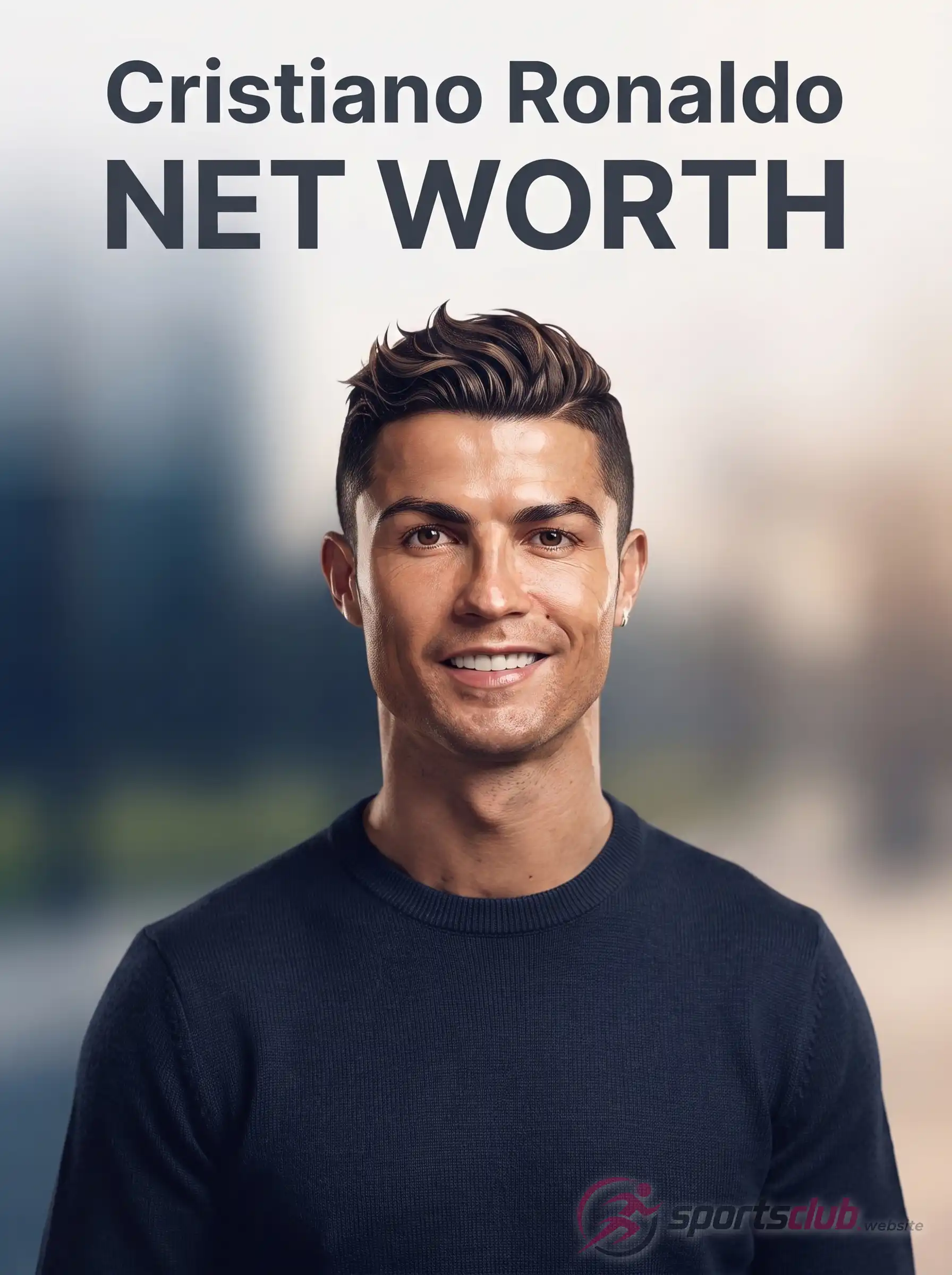
As of 2026, various financial outlets estimate Ronaldo’s net worth at roughly $1.2 billion to $1.4 billion, with his Al Nassr salary reported in the range of $200–240 million per year before bonuses and image rights. Combined with endorsements, business ventures, and social media revenue, his total career earnings are projected by some financial analysts to surpass $2 billion before the end of his current playing contract. In 2020, Ronaldo was reported to have become the first active team-sport athlete to cross $1 billion in career earnings, a milestone that placed him alongside a small handful of individual-sport athletes who had previously reached that figure.
13.3 Ownership Stakes
Did You Know? Ronaldo reportedly holds an equity stake of around 15% in Al Nassr, in addition to his playing salary — an unusually direct ownership arrangement for an active professional athlete, and one that ties his long-term financial interests directly to the success of the club beyond simply his on-field contract.
14. Cristiano Ronaldo Facts for Fans
- Ronaldo was born the youngest of four children in Funchal, Madeira.
- He left home at age 12 to join Sporting CP’s academy in Lisbon.
- His full name pays indirect tribute to former U.S. President Ronald Reagan.
- He wore the famous number 7 shirt at both Manchester United and Real Madrid.
- His 2009 transfer to Real Madrid was a world-record fee at the time.
- He scored 450 goals in 438 games across nine seasons at Real Madrid.
- Ronaldo has won the Ballon d’Or five times.
- He captained Portugal to their first major trophy at Euro 2016, despite being forced off injured in the final.
- He is the all-time leading scorer in men’s international football.
- He became the first player to score at six different World Cups, achieved in 2026.
- He is the UEFA Champions League’s all-time top scorer.
- He moved to Saudi Arabia’s Al Nassr in January 2023 on a free transfer.
- He helped Al Nassr win its first Saudi Pro League title with him on the roster, in 2025–26.
- His combined social media following reportedly exceeds one billion people.
- He scored a memorable hat-trick against Spain at the 2018 World Cup.
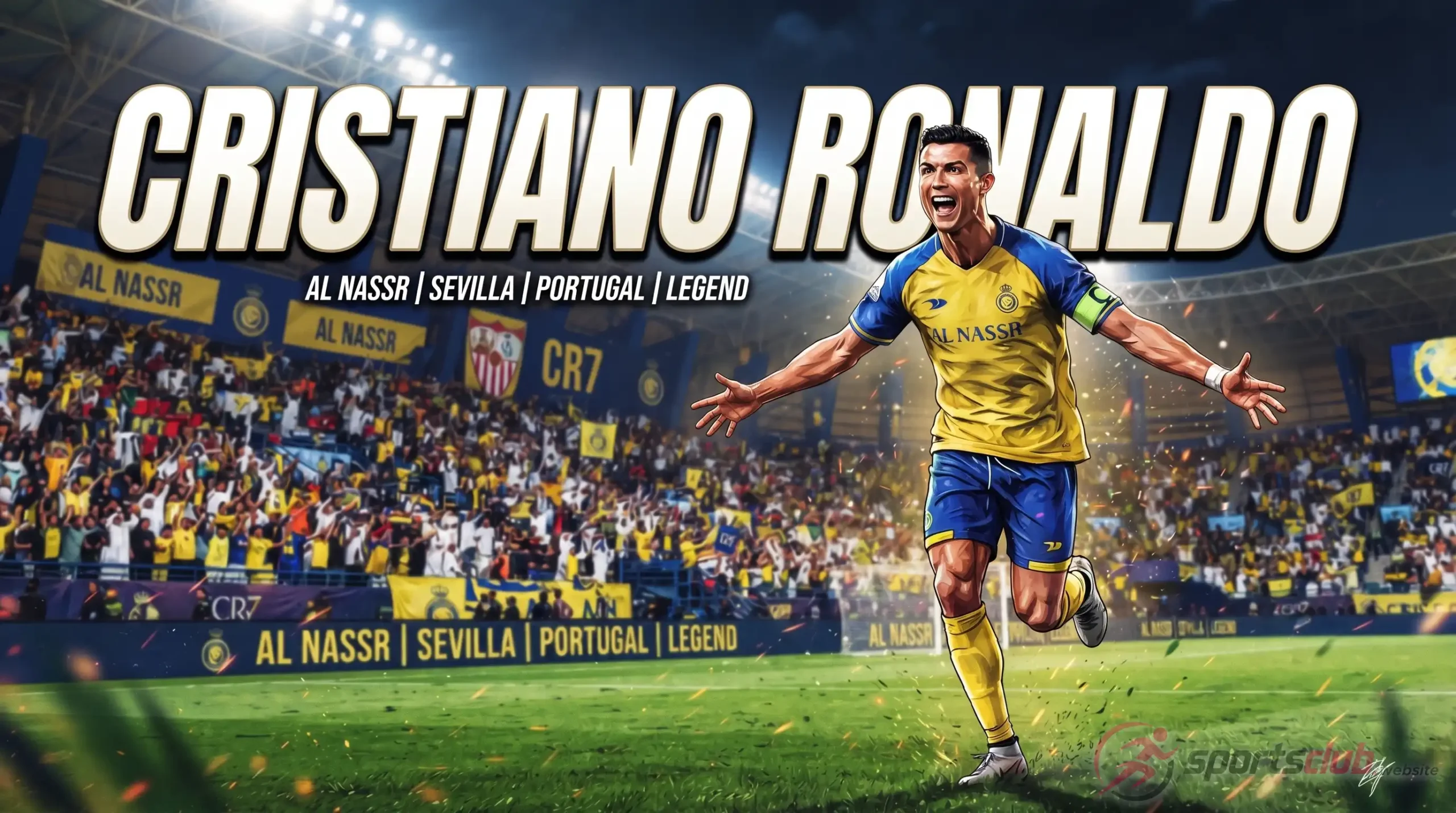
- He has won league titles in four different countries: England, Spain, Italy, and Saudi Arabia.
- His 2014–15 season at Real Madrid, with 61 goals, is considered the statistical peak of his club career.
- He reportedly holds an equity stake of roughly 15% in Al Nassr.
- He is closing in on the historic 1,000 career goals milestone across club and country.
- He has played in six World Cups, spanning 20 years, from 2006 to 2026.
15. Comparison with Peers
| Metric | Cristiano Ronaldo | Lionel Messi | Kylian Mbappé |
|---|---|---|---|
| Ballon d’Or Wins | 5 | 8 | 0 (as of 2026) |
| Champions League Titles | 5 | 4 | 1 |
| Career Club Goals (approx.) | 828+ | 700+ | 300+ |
| International Goals | 146 (record) | 100+ | 45+ |
| World Cup Titles | 0 | 1 (2022) | 1 (2018) |
| Continental Titles (Euro/Copa América) | 1 (Euro 2016) | 1 (Copa América 2021) | N/A |
| Major Leagues Won In | England, Spain, Italy, Saudi Arabia | Spain, France, USA | France, Spain |
| Peak Single-Season Club Goals | 61 (2014–15) | 73 (2011–12) | 44 (2023–24) |
While Messi holds the edge in total Ballon d’Or wins and boasts a World Cup title, Ronaldo’s blend of goal volume, Champions League dominance, and cross-league consistency across four different countries is frequently cited by analysts as arguably unmatched in the sport’s modern era. Mbappé, meanwhile, represents the generation most directly compared to Ronaldo’s early explosive style, though his trophy cabinet — while already including a World Cup title — is still developing relative to the two veterans in terms of individual honors and total career output.
16. Legacy & Impact on Football
16.1 Redefining Commercial Potential
Ronaldo’s influence extends well beyond his statistics. He helped globalize the sport’s commercial potential, demonstrating how an athlete could build a billion-dollar personal brand alongside a playing career, at a scale that had few, if any, true precedents in football before him. His move to Saudi Arabia in 2023 is widely credited with accelerating the Saudi Pro League’s rise as a legitimate destination for elite talent, drawing a wave of established stars in his wake and significantly raising the league’s global broadcast reach and commercial value.
16.2 A Template for Peak Performance
On the pitch, his relentless self-improvement — transforming from a flashy dribbler into arguably the most efficient penalty-box finisher of his generation — has become a template studied by young players and coaches worldwide. Few players in football history have so completely reinvented their playing style across a career while maintaining, and in many statistical respects even improving, their overall output.
16.3 Redefining Athletic Longevity
His longevity, still performing at an elite level into his 40s, has reshaped expectations around athletic career length in professional football. Where a footballer in their late 30s was once assumed to be firmly in decline, Ronaldo’s example — built on rigorous conditioning, nutrition, and recovery science — has pushed clubs, coaches, and younger players to reconsider what is physically possible deep into a football career. His influence on sports science and athlete conditioning practices across the football industry is likely to be studied for years after his eventual retirement.
17. What’s Next — Current Season/Career Outlook
Heading into the 2026–27 season, Ronaldo remains under contract with Al Nassr through 2027, with the club aiming to defend its Saudi Pro League title under new head coach Ange Postecoglou, who took charge of the club ahead of the new campaign. Following an extended post-World Cup break with his family in the wake of Portugal’s elimination, Ronaldo was expected to rejoin full training ahead of Al Nassr’s league opener in mid-August 2026, having missed the early stages of the club’s preseason preparations while recovering from the emotional and physical demands of his sixth World Cup.
His international future with Portugal remains unconfirmed following the team’s 2026 World Cup exit, though he has stated any decision will be made deliberately rather than in the emotional aftermath of the tournament, and he has not ruled out continuing to represent his country in future qualifying campaigns or tournaments.
With his career goal tally closing in on the 1,000-goal milestone across club and country, the coming seasons are likely to be watched closely by fans and statisticians alike, as Ronaldo continues to add to a résumé that already stands among the most complete in the sport’s history.
19. Frequently Asked Questions About Cristiano Ronaldo
1. What is Cristiano Ronaldo’s full name?
His full name is Cristiano Ronaldo dos Santos Aveiro.
2. How old is Cristiano Ronaldo in 2026?
He was born on February 5, 1985, making him 41 years old as of 2026.
3. What club does Cristiano Ronaldo play for now?
As of 2026, he plays for Al Nassr FC in the Saudi Pro League, under contract through 2027.
4. How many goals has Cristiano Ronaldo scored in his career?
As of mid-2026, various trackers place his combined club-and-country tally above 976 goals, with him closing in on the 1,000-goal milestone.
5. How many Ballon d’Or awards has Ronaldo won?
Five — in 2008, 2013, 2014, 2016, and 2017.
6. Has Cristiano Ronaldo won a World Cup?
No. Despite six World Cup appearances, Ronaldo has never won the tournament with Portugal, with the team’s best results including a semi-final finish and, most recently, a round of 16 exit in 2026.
7. What is Cristiano Ronaldo’s net worth?
Estimates for 2026 place his net worth between approximately $1.2 billion and $1.4 billion, factoring in his Al Nassr salary, endorsements, and business ventures.
8. Did Cristiano Ronaldo retire from international football?
He confirmed the 2026 World Cup was his final World Cup appearance but has not confirmed a full retirement from the Portugal national team.
9. How many Champions League titles has Ronaldo won?
Five — one with Manchester United and four with Real Madrid.
10. Is Cristiano Ronaldo the all-time top international goalscorer?
Yes, with 146 goals for Portugal, he holds the record for most goals scored in men’s international football.
11. Which clubs has Cristiano Ronaldo played for?
Sporting CP, Manchester United (two spells), Real Madrid, Juventus, and Al Nassr.
12. What is Ronaldo’s best individual season for goals?
His 2014–15 season at Real Madrid, in which he scored 61 goals across all competitions, is widely considered his statistical peak.
20. Sources & References
[Al Jazeera] – [Source] , [Al Jazeera] – [Source] , [FIFA.com] – [Source] , [Sky Sports] – [Source] , [CBS Sports] – [Source] , [NBC News] – [Source] , [Yahoo Sports] – [Source] , [FOX Sports] – [Source] , [World Soccer Talk] – [Source] , [Celebrity Net Worth] – [Source] , [EssentiallySports] – [Source] , [Bleap Finance] – [Source] , [RonaldoStats.app] – [Source]